

Academic Standards
The foundation of my lesson planning process is identifying academic standards and developing learning objectives that clearly define desired outcomes. This includes prioritizing essential knowledge, key skills, and long-term understanding.

Example of standards and learning objectives from a lesson plan, demonstrating alignment with standards-based instruction (Utah State Board of Education, 2023).
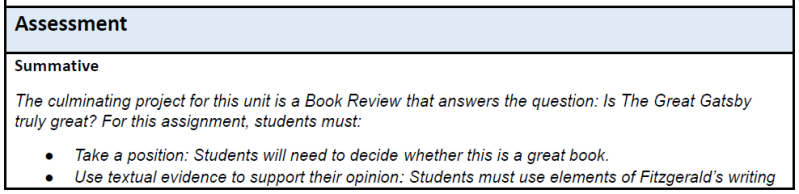
Formative and Summative Assessments
Next, I design formative and summative assessments that allow students to demonstrate mastery and provide data to inform instructional adjustments and differentiation.

Instructional Strategies (Overview)
Finally, I design instructional strategies and learning experiences that help students learn and retain key concepts. This includes incorporating enrichment opportunities for gifted and talented learners, as well as scaffolds for English Language Learners and students with other exceptionalities.
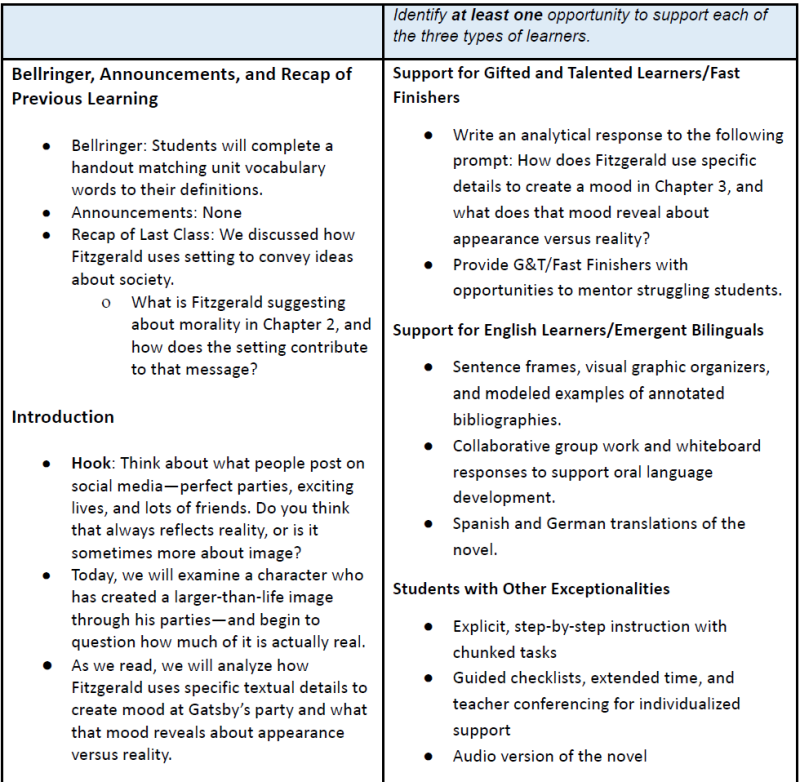
Instructional Strategies (Lesson Structure and Supports)
Reciprocal Teaching
For this lesson, I used reciprocal teaching strategies to support student engagement and close reading.
Reciprocal teaching is an instructional approach that assigns specific roles to each group member, including predictor, clarifier, questioner, and summarizer.
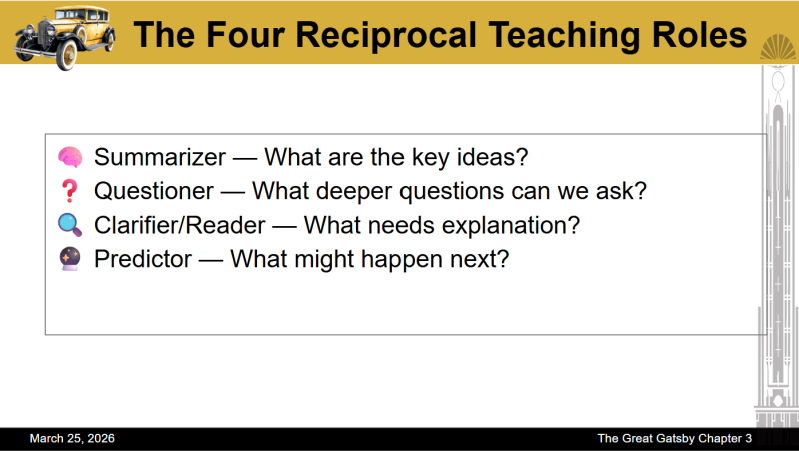
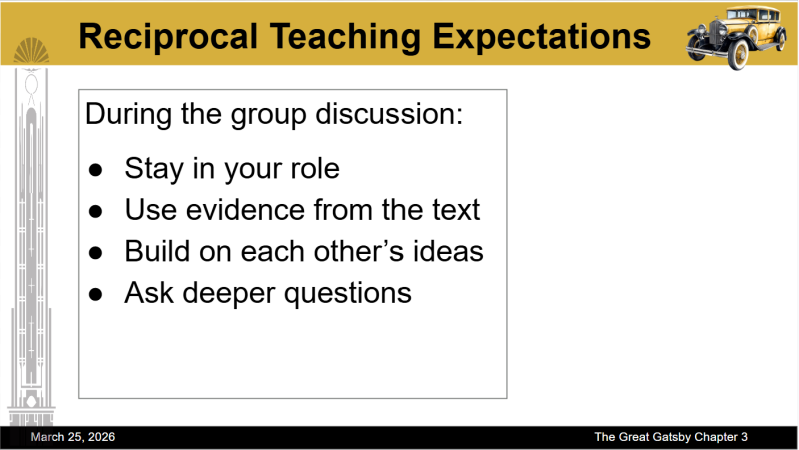
To introduce the concept of reciprocal teaching, I used these two slides.
Higher Order Thinking (HOT)
In this activity, I intentionally incorporated higher-order thinking (HOT) questions to move students beyond surface-level responses.
This approach encouraged students to maintain curiosity throughout the chapter and engage more deeply with key literary elements such as symbolism, irony, and juxtaposition.
Scaffolding and Differentiation
Recognizing that students have varying levels of readiness, I also included “HOT” question sentence starters.
Each group received a laminated reference card to support this process. This scaffolding enabled students who may struggle with writing or processing to participate more fully and confidently in the activity.
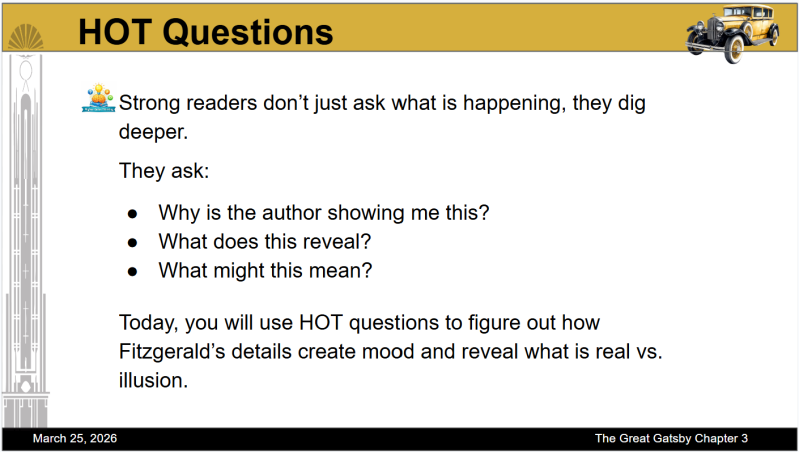
To support this, I created this slide to introduce the concept of higher-order thinking (HOT) questions.
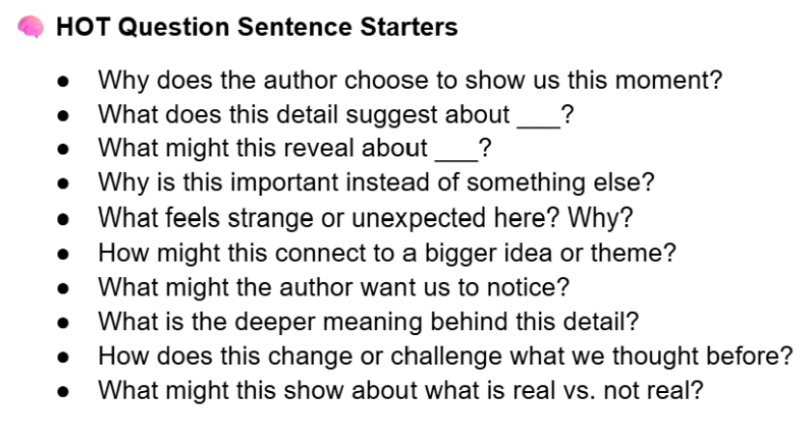
As part of modeling, I created this sentence starter card to support students with varying levels of readiness.
Modeling & Gradual Release
During direct instruction, I modeled the reciprocal teaching process so students could see each role in action.
Before releasing them to practice independently, I also provided a group example to reinforce expectations. This approach helped students better understand their roles and increased their confidence as they engaged in the activity.
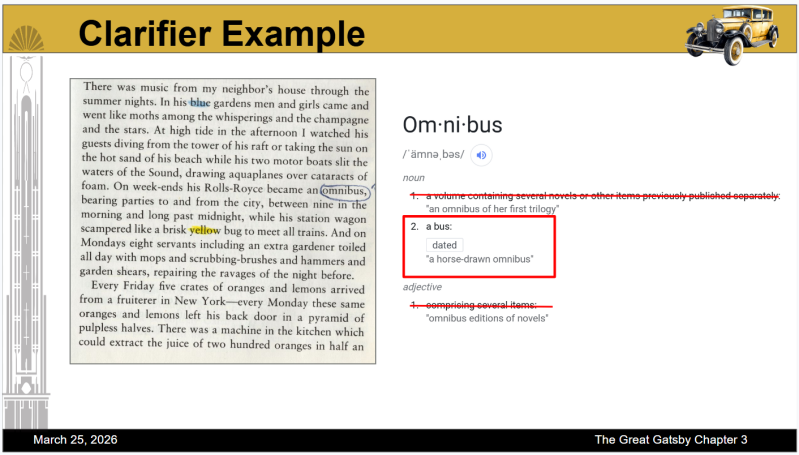
I used this example to explicitly model how the clarifier role supports vocabulary and comprehension during discussion.
Together, these strategies created a structured, collaborative environment that supported both comprehension and deeper analytical thinking.
Student Impact
Student Engagement
This lesson plan emphasizes student learning support by providing intentional scaffolding and structured collaboration. The use of reciprocal teaching increased student accountability and ensured that all students were actively engaged in the reading process. Higher-order thinking questions encouraged students to transition from basic comprehension to deep engagement with literary elements, such as symbolism, irony, and characterization.
Equity & Access
Additionally, the use of HOT question sentence starters provided critical support to students with IEPs and 504 plans, as well as other learners who benefit from structured language support. These scaffolds encouraged a broader range of students to participate in group discussions and communicate ideas with confidence.
Learning Outcomes
During the activity, I noticed that student engagement increased, and students provided textual evidence to support their ideas. I also noticed a shift from surface-level to analytical thinking.
These outcomes demonstrate the importance of intentional instructional design to improve both access to learning and the depth of student understanding.