

This lesson demonstrates how I use historical context, structured discussion, and active reading strategies to help students analyze how Fitzgerald develops theme through characterization.
Lesson Overview
- Text/Unit: The Great Gatsby, Chapter 4
- Grade Level: 11
- Objective: Analyze how the historical context and characterization develop one of the themes of the novel.
- Key Skills:
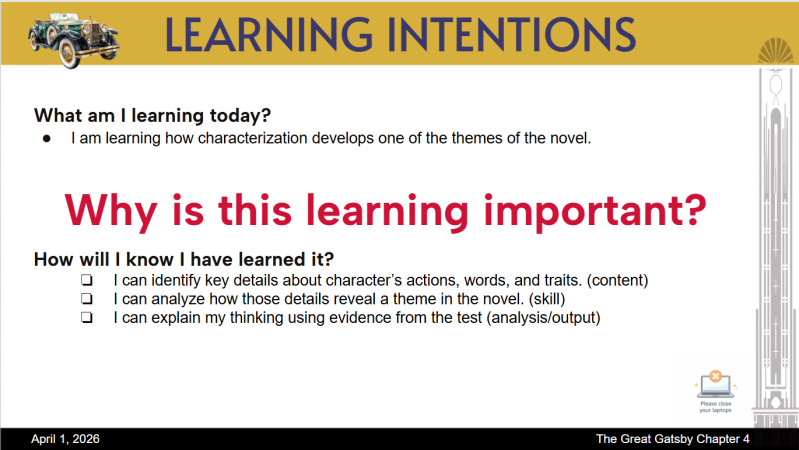
- I can identify key details about a character’s actions, words, and traits. (content)
- I can analyze how those details reveal a theme in the novel. (skill)
- I can explain my thinking using evidence from the test (analysis/output)
This slide communicates clear learning targets and success criteria, helping students understand expectations and monitor their progress toward mastery. It also reinforces the connection between content, skill, and analytical output.

This bellringer activates prior knowledge and engages students in thinking about perception, reputation, and truth. It serves as an entry point into the lesson’s focus on characterization and prepares students for deeper analysis.
Hook/Bellringer
Students generated thoughtful responses and engaged in meaningful discussions about perception, reputation, and truth. This discussion helped activate prior knowledge and prepared students to think critically about Gatsby’s identity and social position.
Instructional Sequence
New Character Introduction - Meyer Wolfsheim
I introduced students to Meyer Wolfsheim to build background knowledge and support comprehension.
Students considered how Wolfsheim’s connections and role as a gangster and gambler complicate our understanding of Gatsby.
Purpose: Build curiosity and connect Wolfsheim to the broader historical context of the 1920s.
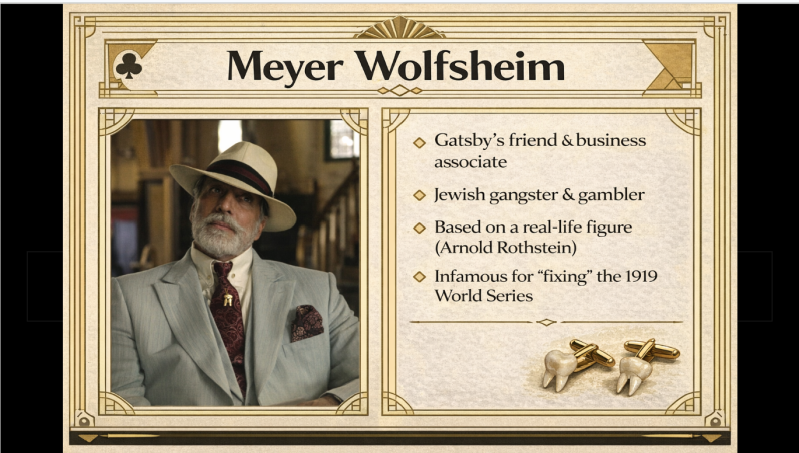
This slide introduces Meyer Wolfsheim and provides key background information to support comprehension. By frontloading this context, students are better able to analyze his role in the text and connect his characterization to the broader historical context.

This slide introduces nativism and provides essential historical context, enabling students to make meaningful connections between the text and the social attitudes of the 1920s.
Build Historical Context
Students were introduced to the concept of nativism. We discussed how fears about jobs, culture, and religion contributed to the development of nativist policies in the mid-nineteenth and early twentieth centuries.
Focus: How fear, economic competition, and cultural differences shaped restrictive immigration policies.
Real-World Application: Students made connections between nativist policies during Fitzgerald’s time and contemporary attitudes toward immigration in the United States.
Literary Discussion Guide
I used an apple tree analogy to scaffold student thinking during literary discussion. The lower branches represent entry-level thinking, such as noticing details and asking questions. As students develop their analytical skills, they metaphorically “use a ladder” to access higher-level thinking, including interpretation, thematic connections, and evaluation. This visual model reinforces that deeper analysis is built through intentional progression.
Cognitive Development:
- Scaffolds thinking from observation to interpretation, and then to analysis
- Supports metacognition by helping students evaluate the depth of their responses

This slide shows how I encourage students to push their thinking to the next level. For students to develop critical thinking skills, they need to understand that their observations need to go deeper than just the surface level basic questions and observations.
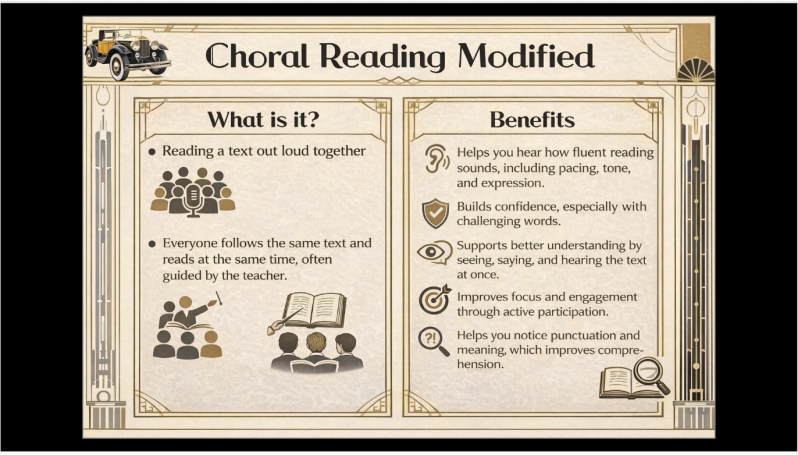
This slide outlines the modified choral reading strategy, which promotes fluency, engagement, and collective participation. By reading aloud together, students are better able to process the text and attend to tone, pacing, and meaning.
Choral Reading (Modified)
For Chapter 4, I decided to do a modified version of choral reading. Instead of having all the students read together, I played the audio version of the book, and students followed along and read along with it.
Benefits:
- Multi-sensory interaction with the text (students are able to see and hear what fluency looks and sounds like.
- Improved focus and engagement because students are actively participating.
Thoughts, Questions, and Epiphanies (TQE)
In this chapter, I introduced students to TQE. This activity requires students to track their thinking by identifying a thought, asking a question, and then connecting their learning to an epiphany--those "aha" moments where things just click.
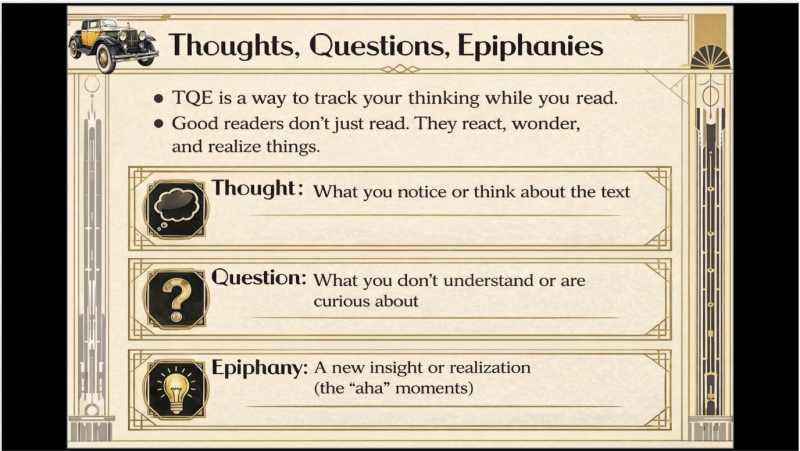
This slide introduces the Thought, Question, Epiphany (TQE) strategy, which provides students with a structured framework for engaging with the text. It supports deeper thinking by guiding students from initial observations to more complex analysis.
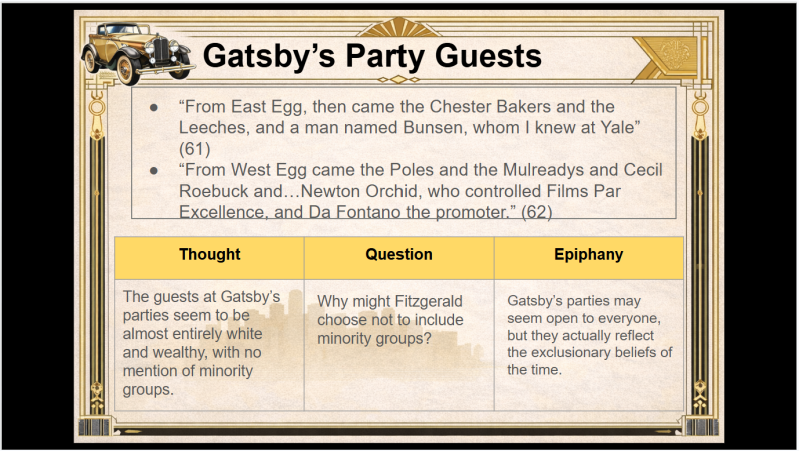
This slide shows students how I use textual evidence to identify a thought, a question, and an epiphany. By modeling the TQE process, I push students to develop literacy skills to help them thoughtfully discuss the author's craft and how that adds to, or detracts from the overall value of the book.
TQE Modeling (I Do)
At the beginning of Chapter 4, Nick lists some of the individuals who attend Gatsby's party. I stopped the audiobook, and demonstrated how to come up with a thought, question, and epiphany. This is important because it allows students to visualize my thought process and make connections.
Wolfsheim's Connegtions
After Gatsby meets Wolfsheim, I used that opportunity to stop and have the students write down a thought, question, and epiphany of their own. While students organized their thinking, I observed students answering questions and offering real-time feedback.

This slide serves as a visual cue to encourage students to use textual evidence to map their thinking.
Instructional Decisions
What Went Well?
For "B" day, I rearranged some slides to improve the flow and refined my thoughts and examples to strengthen my instructional strategies. This made a huge difference in student engagement. In all of my classes, students who are typically more reserved joined the discussion and expressed strong opinions — especially about whether Gatsby is trustworthy. It was fun watching them work through their ideas and express their thoughts to the rest of the class.
What I changed
Learning Intentions: This slide and the associated content have developed throughout the unit. After my first few lessons, I decided to be mor explicitly identifying the content, skill, and output for each objective. This has paid huge dividends, as students can clearly identify the content, skills, and outputs required for mastery.
New Character Introduction: After initially placing the Meyer Wolfsheim slide later in the lesson, I moved it to the beginning based on student needs. This adjustment helped students build background knowledge earlier, which improved comprehension, increased engagement, and led to more meaningful discussions. Students were more confident in their initial interpretations and better able to connect character details to the novel's historical context.
Video Segments: Along with the audiobook, I showed two video clips to provide visual representations of the text. I felt that it was important for students to visualize Nick and Gatsby's interactions during the car ride to New York for lunch. I also wanted to provide a visual representation of when Jordan tells Nick the story of Daisy and Gatsby.
What I Discontinued
During my "A" day class, I decided to try a debate activity. I divided the room in half and had students on one half defend nativist principles, and the other side refute them. This activity fell short for multiple readings. First, I think that the debate went on too long, and the students started to disengage. Second, I think the premise was good, but if I do a debate again, I'll allow students to choose their own sides. Finally, it just didn't have the instructional effect that I thought it would. As a result, I decided to remove the debate from my lesson plan.
Student Thinking
Students recognized that Gatsby’s world appears inclusive but is, in fact, socially exclusive. They identified patterns in the guest list and linked them to broader nativist attitudes of the 1920s. Through discussion and TQE responses, students moved from initial observations to deeper analysis about how historical context shapes characterization and theme.
Why this Matters
This lesson reflects my approach to teaching literature by integrating historical context, structured discussion, and active reading strategies. By making thinking visible and connecting literature to real-world issues, students move beyond surface-level responses and engage in deeper, more meaningful analysis.